Education access is often described as a single moment: a child gets enrolled, a school year begins, and the expectation is that learning will follow naturally. But for many children ELOI Africa serves, “access” is not automatic—and it isn’t guaranteed to last. Real access means children can attend consistently, read and understand what they are taught, and remain supported through the everyday challenges that disrupt learning.
In this context, literacy is not just about recognizing letters or sounding out words. Literacy is the foundation that helps a student interpret the world around them. It helps them understand classroom instructions, read information related to health and safety, participate confidently in group learning, and use education as a pathway to a future they can shape. When literacy is weakened, the impact is not limited to schoolwork; it affects how a child navigates daily life.
1) Literacy changes what a student can do every day
A child who can read confidently can:
- understand and follow written directions at school,
- interpret basic information in daily life,
- comprehend learning materials without needing constant help,
- and communicate more clearly with teachers, peers, and family members.
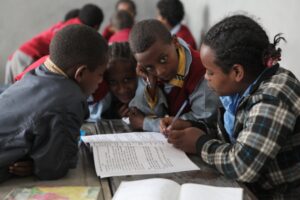
That matters because many learners do not struggle because they “cannot learn,” but because literacy skills are not protected early enough. A child may enter primary school with limited reading support, and as lessons become more complex, gaps widen. When reading and comprehension fall behind, the classroom can start to feel like a place where they are always catching up—and eventually, some children begin to withdraw, disengage, or leave school entirely.
2) Access is not the same as completion
Even when enrollment happens, education access can still be fragile. For rural families and vulnerable households, maintaining attendance can be disrupted by needs at home, economic pressures, illness, or the lack of learning materials. In these situations, education access becomes a cycle: a child may begin school, but the support needed to stay in school and progress learning milestones is not always there.
ELOI Africa’s work reflects the reality that education access must include continuity. Enrollment is only the start; lasting impact requires support that helps a child remain in school long enough to build foundational skills—especially early literacy.
3) Why support has to connect learning to life
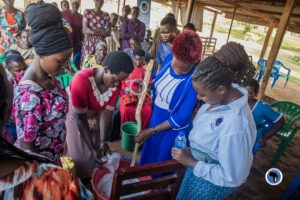
Many literacy challenges are not solved by reading instruction alone. Children learn best when learning is connected to real tasks and real confidence. When literacy support includes life skills—such as understanding written guidance, communicating effectively, and using reading to navigate everyday situations—it becomes more durable.
This is why literacy support should be treated as empowerment, not only as “academic progress.” When students learn to read, they gain the ability to act with more understanding and less fear. They can read instructions, ask questions, and participate in learning with more confidence. Over time, that confidence becomes part of how they see themselves: not as someone who is left behind, but as someone who can learn, adapt, and continue.
4) School outreach and sponsorship as continuity support
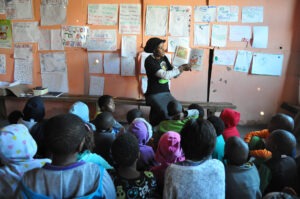
One of the biggest threats to education access is interruption—when a child leaves school because the household cannot sustain the time, materials, or stability required for learning. ELOI Africa’s approach emphasizes continuity support, including community and school outreach and sponsorship models intended to help protect a child’s learning journey over time. (eloiafrica.org)
When continuity is supported, literacy has room to grow. Students can build vocabulary, strengthen comprehension, and learn to read for understanding—not only to finish lessons, but to keep learning beyond the early grades.
5) Education access is also a dignity issue
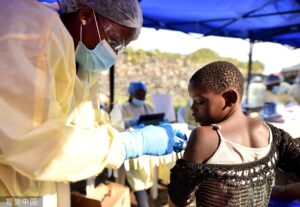
Children are not only future workers or students—they are people with dignity now. When children gain literacy, they gain agency: they can interpret instructions, understand health information, communicate effectively, and participate more fully in community life. Education access therefore becomes more than a development goal; it becomes a respect for the child’s right to learn and the family’s hope that learning will last.
ELOI Africa’s mission—“Hope for an African Child”—captures that truth: hope becomes durable when learning is protected and supported over time. (eloiafrica.org)
Conclusion
Literacy is liberation because it expands what a child can do, what a child can understand, and what a child can pursue. But literacy grows only when the conditions around a learner are protected—through consistent attendance, early support, continuity, and access to learning opportunities that do not disappear midstream.
Education access is not a checkbox. It is a system of support that allows children to become confident readers, lifelong learners, and young people prepared to contribute to their communities.